One of the toughest parts of being a Product Manager is making decisions.
Every time you say yes or no to something, you're placing a bet. You rarely have all the information you need, and you never know for certain whether you've made the right call.
In a leadership position, this becomes amplified.
At some point, the team needs clarity. Discussions can only go on for so long. Eventually, someone needs to make the call and help the team move forward.
At the recent Products at Heart conference, I had the privilege of sitting along Martin Eriksson, Martin Eriksson who wrote about the Decision Stack. Something he shared really resonated with me.

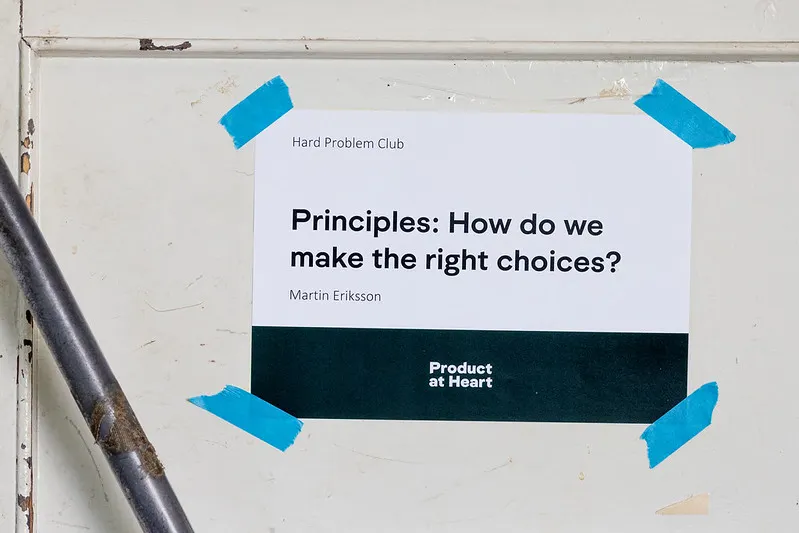
When teams keep having the same conversations, asking the same questions, and going around in circles, that's often a sign that a decision needs to be made.
We explored some of the common tensions we face in product:
Acquisition or retention?
Quality or quantity?
Centralized or decentralized?
There is rarely a perfect answer. And even when you make a decision, you won't always know whether it was the right one.
This is where principles become important.
Clear principles give teams a foundation for making decisions when the answer isn't obvious. They help us navigate uncertainty without having to start every conversation from scratch.
The sooner you make a decision, the sooner you can learn.
You might move forward and discover you were right.
You might learn you were wrong and change course.
Both are better than staying stuck at the junction, endlessly debating which road to take.
That's one of the lessons I took away from the conversation: good decision-making isn't about always being right. It's about creating enough clarity to move, learn, and adapt.
If you want to explore this topic further, I highly recommend picking up Martin Eriksson's book on the Decision Stack (not paid ad by the way 😉 )