In my early days in the workforce, long before stepping into a Product Manager role, the word strategy intimidated me. Being told to “think more strategically” felt abstract and uncomfortable. I often found myself wondering: what does that actually mean?
I explored frameworks, read books, and learned from leaders. Still, strategy felt vague, sometimes overcomplicated, sometimes scattered across documents and slide decks.
It only really clicked after a straightforward conversation with a product leader I deeply
admire, Sofia Simões de Almeida, now Product Director at Talabat / Delivery Hero.
She shared how she worked on strategy with her team. The things stuck with me:
Questions to answer around strategy
You can use any format you like. Keep it simple. It can even be a one-page document.
Through time, I’ve started breaking down strategy down into a few core components to provide guidance. I also like to also distinguish between working around the strategy and working on the strategy itself; a difference that matters more than it first appears.
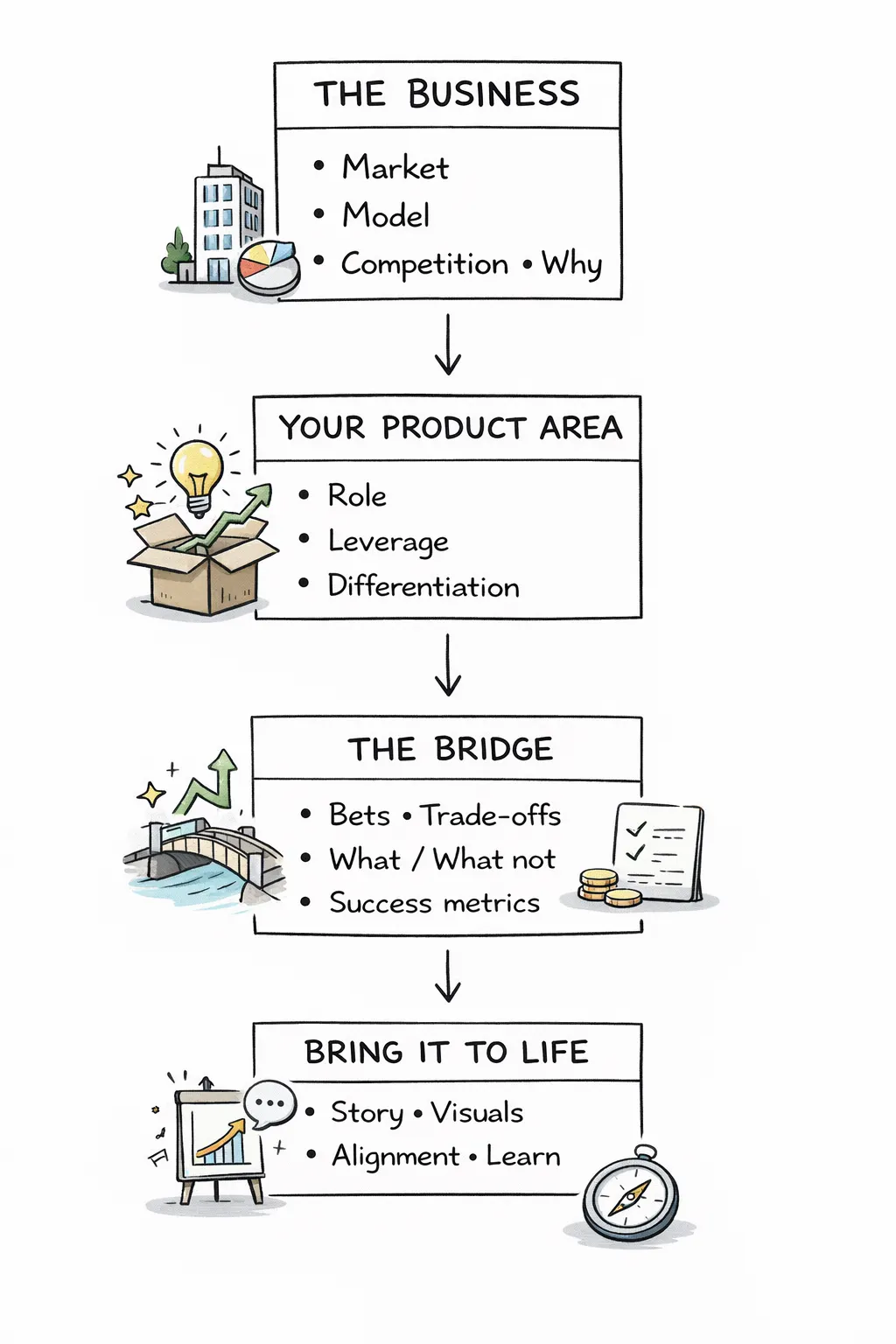
Component 1: The Business
This is the foundation of any meaningful product strategy.
Without a solid understanding of the business model, market dynamics, competitive landscape, and overall direction, it is nearly impossible to make sound strategic decisions. This is the work that happens around the strategy.
It cannot be done in isolation. It requires conversations across the organization, exposure to different perspectives, and a willingness to ask fundamental questions. Strategy begins with understanding how the business creates value and what constraints it operates within.
Component 2: Your Product Area
Once the business context is clear, the next step is to connect it explicitly to your product area.
This requires looking beyond your immediate scope, understanding industry patterns, comparable solutions, and emerging approaches. Today, AI can accelerate this exploration significantly, but judgment remains critical. Outputs still need validation, context, and interpretation.
Ask yourself:
What role does my product area play in business success?
Where does it enable, accelerate, or differentiate?
When I was a PM for Data and Tech Platform teams, this connection took longer to form. But once it clicked, decision-making became significantly easier. I’ll share more on strategy for Platform teams in a future post.
Component 3: The Bridge
This is where strategy moves from context to commitment.
The bridge connects direction to decisions and makes trade-offs explicit. This is the work on the strategy.
Here, you connect direction to decisions:
How can your product area contribute to business success?
Who are your users and do you know how to attract and retain users of your product?
What are the big bets versus quick wins?
What will you deliberately not do? Choosing what not to pursue is just as important as choosing what to focus on.
How will you measure success?
Clarity at this stage enables teams to operate with autonomy while remaining aligned.
Component 4: Bring It Together
A strategy only works if it is understood and shared.
Once you have a first version, think about how to communicate it. AI can be a useful partner here, including as a first review or structuring aid.
Clear storytelling and simple visualization often help align teams and stakeholders. Strategy only works if it is understood and shared.
A final thought
Remember: strategy is a bet. A well-articulated strategy doesn’t remove uncertainty, it helps teams navigate it with intent.
It needs to be validated through the opportunities you pursue over time. This way of thinking helped me, I hope it sparks something useful for you too!