As AI makes execution faster, the competitive advantage may shift from how many people an organisation has to how much ownership, expertise and judgement each person brings.
The dawn of AI has brought with it an extraordinary promise: we can build more, do more and move faster than ever before.
Ideas that once took weeks to prototype can now take days. Tasks that required several people can increasingly be handled by one person with the right tools. Teams can experiment more frequently, test assumptions earlier and bring products to market at a pace that would have seemed unrealistic just a few years ago.
But with these possibilities comes a new expectation.
Move faster. Ship more features. Make quicker decisions. Respond to customers before competitors do. Don’t get left behind.
As AI lowers the cost of execution, the pressure to increase the pace of innovation will only grow.
And this raises a more fundamental question: if the way we work is changing so dramatically, shouldn’t the way we organise ourselves change too?
The problem with the traditional organisational structure
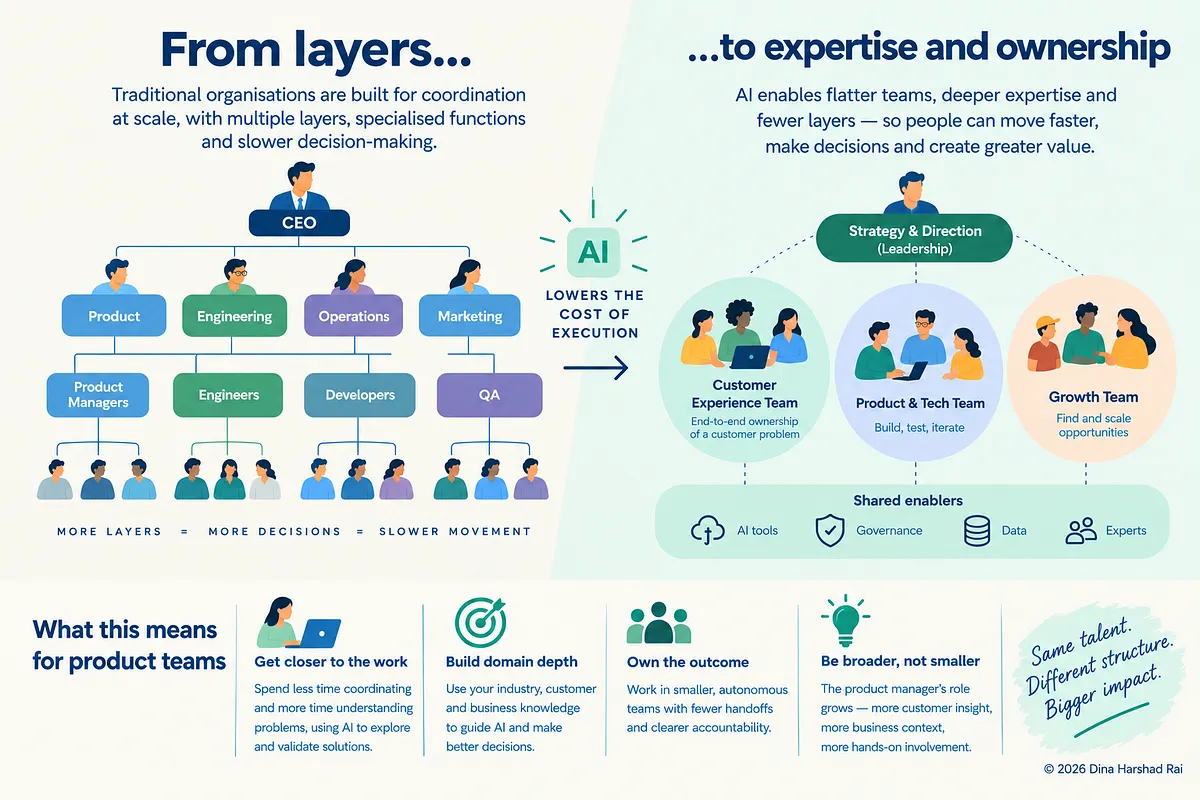
Most organisations are built for coordination at scale.
As companies grow, they introduce layers of management, specialised functions, approval processes and governance mechanisms. These structures exist for good reasons. They help organisations manage risk, align teams, maintain quality and operate consistently across increasingly complex businesses.
But they also introduce friction.
A product decision might move from a product manager to an engineering lead, then to a director, before reaching another team that needs to approve the work. Information travels up the organisation and decisions travel back down. Each layer adds context, but potentially also adds time.
What works when an organisation is managing thousands of employees can become a liability when the market demands rapid experimentation.
The problem isn’t necessarily that there are too many people. It’s that the distance between identifying a problem and acting on it can become too great.
AI makes this tension harder to ignore. When a team can build a prototype in a day, waiting two weeks for alignment, prioritisation and approval begins to look increasingly absurd.
The bottleneck is no longer always the ability to execute. Increasingly, it’s the ability to decide what matters, make sound decisions and take action without unnecessary dependencies.
The great flattening
We’re already seeing organisations rethink their structures in response to this shift.
In October 2025, Amazon announced further organisational changes focused on reducing layers, increasing ownership and removing bureaucracy, explicitly connecting a leaner structure to the pace of change enabled by AI.
Meta has reorganised its AI teams to create clearer ownership and reduce dependencies. In February 2026, Block announced a major workforce reduction, with Jack Dorsey arguing that AI tools combined with smaller, flatter teams were changing how companies could operate.
These are different companies facing different circumstances, and restructuring should not automatically be interpreted as proof that AI alone is responsible for every job reduction. But the direction of travel is worth paying attention to.
The emerging organisational model places greater emphasis on fewer layers, clearer accountability and teams that can act with more autonomy.
The logic is straightforward: if technology allows a smaller group of people to accomplish more, the organisation may not need the same amount of coordination overhead to get work done.
But flattening an organisation isn’t simply a matter of removing managers from an org chart. Remove a layer without changing decision rights, and decisions may still get stuck. Give people more responsibility without the necessary context, and you create confusion rather than autonomy. Increase the number of direct reports each manager has without rethinking their role, and you risk losing coaching, mentorship and support.
A flatter organisation is not necessarily a faster organisation. A better-designed one is.
The real question is what replaces the structure we’re moving away from.
From coordination to expertise
For years, many organisations have relied on specialisation and coordination as their primary means of scaling. As a company grows, work is divided into narrower roles. One person owns strategy, another delivery, another research, another analysis. Managers help connect these pieces and ensure that the organisation moves in the same direction.
AI challenges some of the assumptions behind this model. When individuals can use AI to conduct research, analyse data, generate prototypes, write code and automate routine tasks, the boundaries between roles can become more permeable.
This doesn’t mean everyone suddenly becomes an expert in everything. Nor does it mean specialist knowledge becomes less valuable.
In many cases, the opposite is true.
When execution becomes easier, judgement becomes more important.
Generating ten possible solutions is relatively easy. Knowing which one solves the right problem is harder. Producing a prototype is easier. Understanding whether it will work within a complex technical environment, regulatory constraint or customer workflow requires deeper expertise.
The value of a person increasingly lies not just in the tasks they can perform, but in the quality of the decisions they make.
This could lead to organisations that value greater domain depth, stronger business understanding and more hands-on expertise.
People who understand the customer, the market, the technology and the economics of the business will be better positioned to use AI effectively. They can connect insights across disciplines, challenge the output of AI tools and make decisions that account for the wider context.
Instead of building large teams to move information between specialists, organisations may increasingly rely on smaller teams with broader capabilities and deeper ownership.
The shift is subtle but significant: from managing the handoffs between people to empowering people who can take an outcome from problem to solution.
Are we moving back to startup culture?
In some ways, yes.
Think about an early-stage startup. The product manager speaks directly to customers. The engineer understands the business problem. The designer participates in product decisions. The founder is close enough to the work to understand what’s happening on the ground.
There are few layers between insight and action.
People operate beyond their formal job descriptions because the business cannot afford rigid boundaries. Decisions are made quickly, feedback loops are short, and everyone understands that the outcome matters more than the process.
As the startup scales, this changes. Roles become more specialised, processes emerge, and management layers are introduced to maintain consistency and coordination.
This is often necessary. But over time, the structures that helped a company scale can also distance people from the problems they are supposed to solve.
AI may give larger organisations an opportunity to recover some of the advantages of being small, without having to become small again.
A team of three or five people, equipped with AI tools and the right expertise, may be able to research a problem, develop a solution, test it with customers and ship an improvement without involving a dozen people across multiple departments.
The ambition is not to recreate the chaos of an early-stage startup. It is to combine the focus and ownership of a startup with the resources, knowledge and reach of an established organisation.
In other words, the future may belong to companies that can operate like a collection of small, empowered teams rather than one large machine.
But there’s an important distinction.
Startup culture is not inherently better. Small teams can make poor decisions, duplicate work and overlook risks. Large organisations have capabilities that small companies lack.
The opportunity is to retain the advantages of scale while reducing the friction that scale creates.
What does this mean for product teams?
For product teams, I think the implications are particularly interesting.
AI is changing not only how products are built, but also what we should expect from the people building them.
1. Product managers will need to get closer to the work
If building and experimenting become cheaper, product managers should be able to spend less time coordinating the production of artefacts and more time understanding problems.
That means spending more time with customers, developing a sharper understanding of the business, interrogating data and forming a point of view on what should be built.
It also means being more hands-on.
A product manager who can use AI to explore a solution, build a rough prototype, query a dataset or test an assumption can bring more evidence into a decision before involving the rest of the team.
This doesn’t mean every product manager needs to become an engineer or designer. It means the distance between having an idea and exploring whether it is worth pursuing should shrink.
The expectation should shift from managing the process of getting work done to taking greater ownership of the outcome.
2. Domain knowledge will become a differentiator
When everyone has access to similar AI tools, access to the tools themselves becomes less of a competitive advantage.
What differentiates teams is how well they understand the problem they’re trying to solve.
A product manager who deeply understands the workflows of a particular industry, the constraints customers face and the commercial drivers behind their decisions will be better equipped to direct AI towards meaningful solutions.
They’ll also be better at recognising when an apparently impressive solution is addressing the wrong problem.
This is where business depth matters.
Understanding revenue models, unit economics, operational constraints, customer behaviour and competitive dynamics cannot be replaced by simply becoming more proficient at prompting an AI tool.
The more we automate execution, the more valuable it becomes to know what is worth executing.
3. Teams may become smaller, but their ownership will become larger
Traditional product teams often divide responsibilities across multiple roles and functions. This can work well, but it can also create a situation where everyone owns a piece of the process and nobody truly owns the outcome.
AI creates an opportunity to rethink that arrangement.
Instead of organising around a sequence of handoffs, teams could organise around customer problems or business outcomes.
A small, multidisciplinary team might own a specific customer journey, from identifying friction to designing, building, launching and measuring improvements.
The team would have the tools and authority to make most decisions independently, escalating only when decisions genuinely require wider alignment.
The important change is not simply fewer people. It is fewer dependencies.
A team should be able to move quickly because it has the context, capability and authority to do so.
4. The product manager’s job may become broader, not smaller
There’s a temptation to assume that AI will reduce the need for product managers because it can generate requirements, analyse feedback, summarise research and help build software.
But producing these artefacts is only one part of product management.
The harder questions remain:
Which customer problem is worth solving?
Why does it matter to the business?
What should we prioritise when resources are constrained?
What trade-offs are we willing to make?
How will we know whether we’ve created value?
AI can help us explore these questions. It cannot remove the need to take responsibility for answering them.
As execution becomes more accessible, product managers may be expected to cover more ground: stronger customer discovery, sharper commercial judgement, greater technical fluency and more direct involvement in experimentation.
The role may become less about orchestrating a process and more about owning a problem end to end.
That is a meaningful shift in expectations.
The danger of confusing speed with progress
Of course, there is a risk in this new model.
If AI enables teams to ship features faster, organisations may respond by demanding more features. If managers can oversee more people, organisations may increase their spans of control without considering the consequences. If fewer people can produce more output, companies may optimise for headcount reduction rather than customer value.
We could end up with organisations that are leaner on paper but more exhausted in practice.
We could also end up with products that accumulate features faster than anyone can determine whether they are useful.
Speed is only an advantage when it helps an organisation learn faster, make better decisions or deliver more value.
The purpose of a product team is not to maximise the number of things shipped. It is to solve meaningful problems for customers in ways that sustain the business.
And the purpose of an organisation is not to eliminate every layer of management. It is to create the conditions in which people can do their best work, make sound decisions and achieve outcomes that individuals cannot achieve alone.
Some work still requires coordination, careful governance, deep specialisation and experienced leadership. The challenge is to apply those things where they add value, rather than making every team pay the same coordination cost.
So, what will the organisation of the future look like?
I don’t think the future organisation will simply be a flatter version of today’s company. I think it will be organised differently around the relationship between expertise, autonomy and accountability.
It may have fewer layers between decision-makers and the work. It may rely on smaller teams with clearer ownership. It may expect individuals to combine functional skills with deeper business and domain knowledge. And it may use AI to reduce the administrative and coordination work that has accumulated as organisations have grown.
Management won’t disappear. Its value may shift away from controlling the flow of work and towards setting direction, developing people, resolving genuine conflicts and ensuring that autonomous teams remain aligned.
Specialists won’t disappear either. Their expertise may become even more valuable, particularly where the work involves complexity, risk or decisions that require deep technical understanding.
What may disappear, or at least become harder to justify, are the layers and processes that exist primarily to move information, seek permission or coordinate work that teams could reasonably handle themselves.
The organisation of the future may therefore look less like a pyramid and more like a network of small, capable teams connected by a clear strategy and shared goals.
And AI will be the infrastructure that allows those teams to operate with greater reach.
A final thought
Perhaps we’re not moving towards a world where organisations need fewer talented people. We’re moving towards a world where talent is expected to operate differently.
Less waiting for instructions. Less reliance on layers of coordination. Less separation between understanding a problem and doing something about it.
More expertise. More ownership. More business context. More direct involvement in the work.
In many ways, this sounds like the culture of an early-stage startup. The difference is that AI may allow established organisations to adopt that way of working at a much greater scale.
For product teams, this is both an opportunity and a challenge.
The opportunity is to spend less time managing the mechanics of delivery and more time creating meaningful customer and business outcomes.
The challenge is that when the tools make execution easier, there is less room to hide behind the process.
Ultimately, AI may not just change how quickly we build products. It may change what we expect from the people who build them, how we organise those people, and what it means to be effective inside an organisation.
When everyone can build faster, the advantage will belong to the organisations that know what to build, why it matters, and how to empower the people closest to the problem to make it happen.